Recognising a Vermeer in three seconds
A window on the left, a silent interior, a blue more precious than gold: the master of Delft’s paintings are rare, and that is precisely what makes them so easy to recognise.
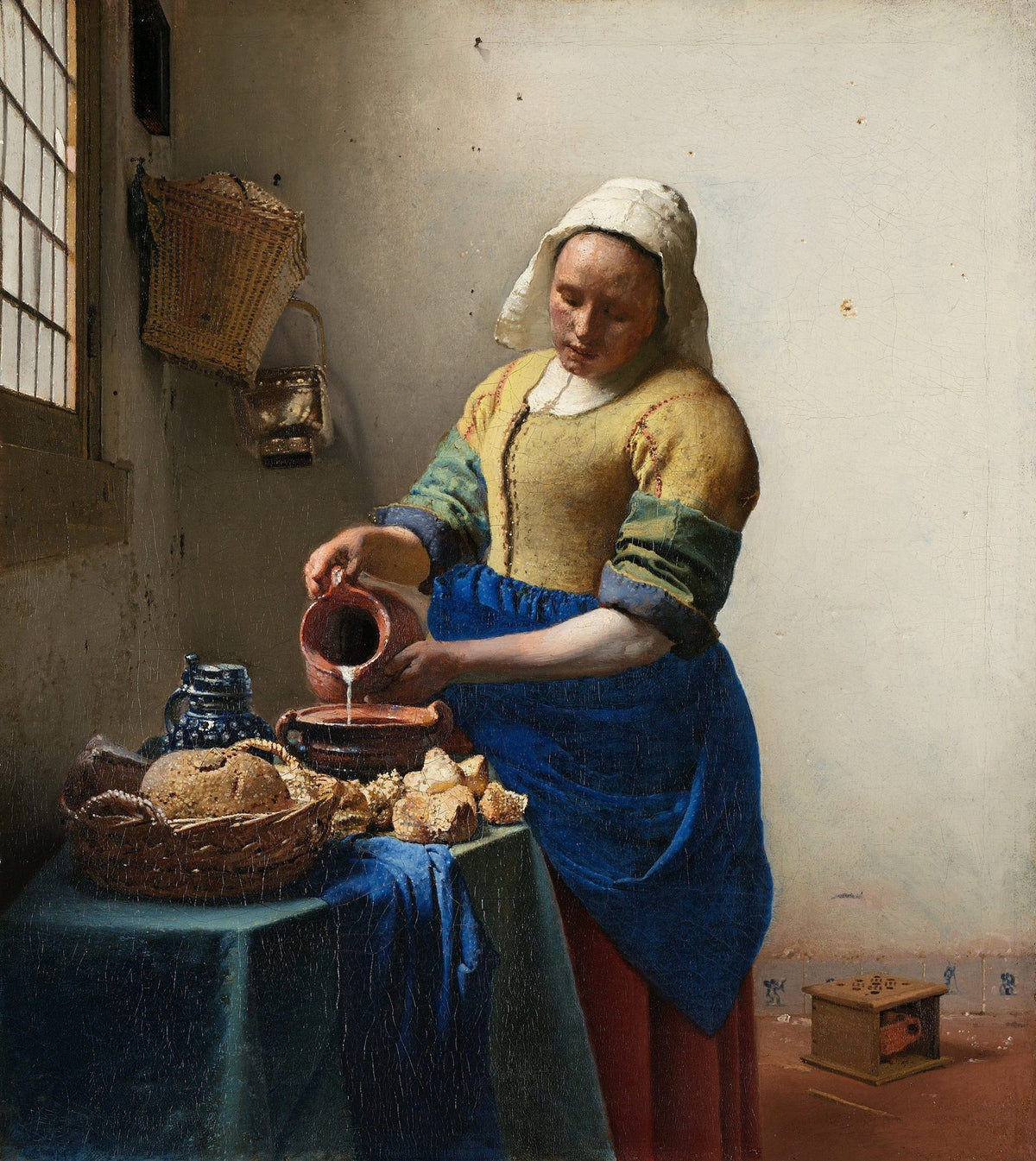
Around thirty-five paintings are attributed to Johannes Vermeer today. That is very few for a painter who worked for some twenty years. His contemporaries sometimes produced hundreds. This rarity, and the perfection of each of his canvases, have made him one of the most loved painters in the world, although he was almost forgotten less than two centuries after his death.
A painter from Delft
Vermeer was born in Delft in 1632 and spent his whole life there, in a prosperous town of the Dutch Republic at the height of its Golden Age. He was also an art dealer. We know little about him: no letters, no diary, no certain self-portrait. He died in 1675, aged forty-three, leaving a widow, many children and debts. His work fell into obscurity for nearly two centuries, before being rediscovered in the nineteenth century by the French critic Théophile Thoré-Bürger, who nicknamed him “the Sphinx of Delft”.
Light from the left
This is the first clue, and the surest. In most of his interiors, a window opens on the left of the composition, and a soft, almost milky light slides across a white wall, a tablecloth, a face, a jug. This light does not merely illuminate the scene; it is its true subject. It gives the simplest objects an almost sacred presence.
A suspended gesture
A woman reads a letter by the window. A maid pours milk. A young woman plays the virginal. Nothing happens, and yet everything seems held in suspense. The figures are alone or nearly so, absorbed in a task, as if caught in a moment of privacy. You often feel you are entering the room on tiptoe.
Ultramarine blue
Vermeer readily used natural ultramarine, a pigment made by grinding lapis lazuli, a stone imported from Afghanistan. At the time it cost more than gold. It appears on the turban of the Girl with a Pearl Earring, on the apron of The Milkmaid, on dresses and chairs. This intense blue, set against yellows and whites, is one of the most recognisable signatures in painting.
The little points of light
Move closer to a Vermeer and you will see, on bread, metal or porcelain, tiny raised points of light. They are droplets of pale paint imitating the gleam of light on surfaces. Some historians have suggested that the painter used a camera obscura, an optical device that projects an image, to compose his scenes. The hypothesis is still debated.
The Girl with a Pearl Earring is not strictly a portrait. Art historians see it as a tronie, a Dutch genre depicting an expressive face or a type, often in exotic costume, rather than a specific person. Her model remains unknown.
Where to see them
| Painting | Museum |
|---|---|
| The Milkmaid | Rijksmuseum, Amsterdam |
| Girl with a Pearl Earring | Mauritshuis, The Hague |
| View of Delft | Mauritshuis, The Hague |
| The Lacemaker | Musée du Louvre, Paris |
| The Astronomer | Musée du Louvre, Paris |
Vermeer’s works are scattered across some fifteen museums around the world, and seeing all thirty-five has become a kind of pilgrimage for some enthusiasts.
Look at the light on the wall. That is what tells the story.
That is the line to murmur in front of a Vermeer. It is accurate, it is simple, and it shows you looked at the painting rather than the label.


