The French New Wave, simply explained
In the late 1950s, a band of young critics decided French cinema had grown too polite. They picked up the camera, took to the streets and invented a way of filming that still inspires directors around the world.
Paris, 1959. A fourteen-year-old boy runs away, steals a typewriter, ends up in a juvenile centre, escapes and runs all the way to the sea. The film freezes on his face, looking straight into the camera. It is called The 400 Blows, it was directed by a twenty-seven-year-old critic, François Truffaut, and it wins Best Director at the Cannes Film Festival. The New Wave has just been born.
Critics turned filmmakers
Before making films, they watched them, thousands of them, at Henri Langlois’s Cinémathèque française, and they talked about them. Their names were François Truffaut, Jean-Luc Godard, Claude Chabrol, Éric Rohmer and Jacques Rivette, and they wrote for a magazine founded in 1951, the Cahiers du cinéma. There they mercilessly attacked what they called the “tradition of quality”: well-made, well-lit, well-written films, shot in the studio and, in their view, soulless.
Their big idea fits in a phrase, the “auteur theory”. A film belongs neither to its screenwriter nor its producer; it belongs to its director, just as a novel belongs to its writer. They championed Hollywood directors whom the critics of the day looked down on, such as Alfred Hitchcock and Howard Hawks, and raised them to the rank of artists.
The films to know
- Le Beau Serge, by Claude Chabrol (1958), often cited as the movement’s first film.
- The 400 Blows, by François Truffaut (1959).
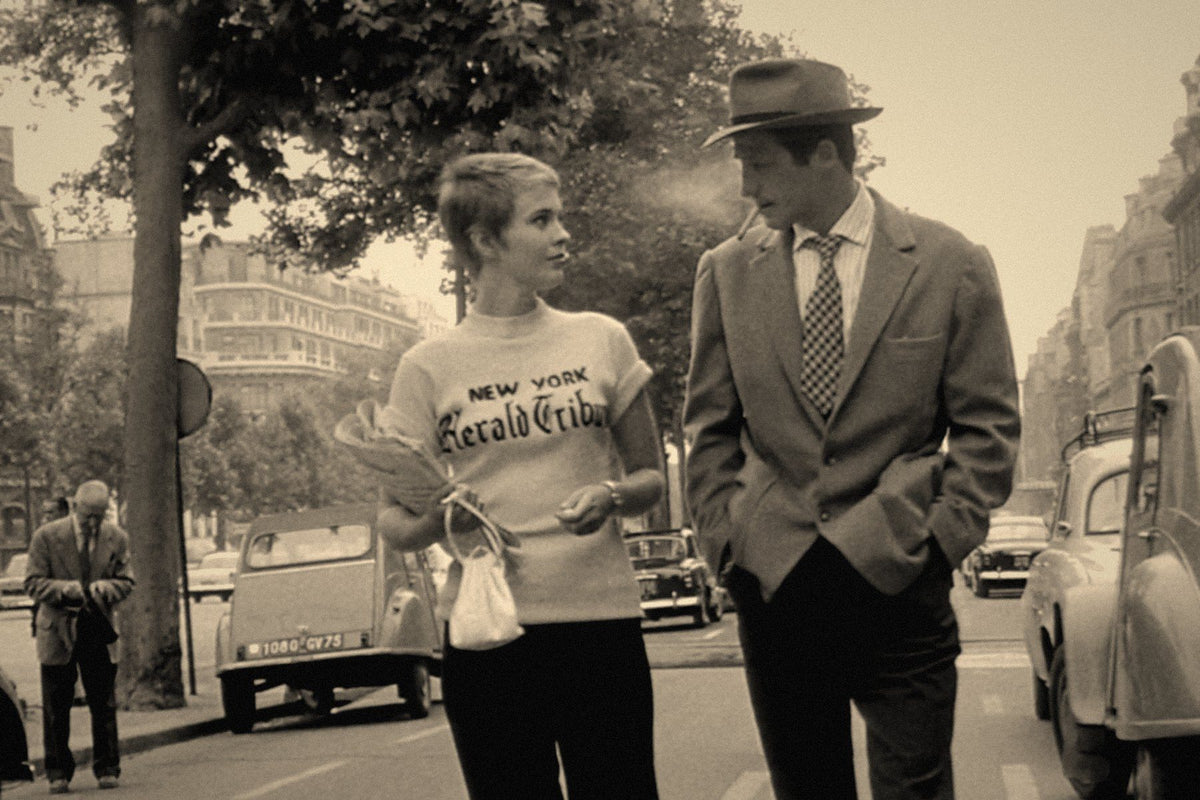
- Breathless, by Jean-Luc Godard (1960), with Jean-Paul Belmondo and Jean Seberg.
- Cléo from 5 to 7, by Agnès Varda (1962), a late afternoon in Paris filmed almost in real time.
- Jules and Jim, by François Truffaut (1962), with Jeanne Moreau.
- Contempt, by Jean-Luc Godard (1963), with Brigitte Bardot and Michel Piccoli.
How to recognise it
New Wave films were often shot on very little money, and that constraint became a style. They were filmed in the street, in real apartments, in natural light. The camera is light, often handheld, and follows the actors as they move. Dialogue seems improvised, actors sometimes look into the lens, and the editing dares what classical cinema forbade.
The famous jump cuts in Breathless, those abrupt cuts in the middle of a shot that make the image leap, are said to have been born of necessity: the film was too long, and Godard chose to cut within scenes rather than remove entire ones. The technique became a signature, imitated to this day in music videos and adverts.
Paris as the leading role
The New Wave filmed Paris as no one had before. The Champs-Élysées in Breathless, the Left Bank and Parc Montsouris in Cléo from 5 to 7, the buildings of Pigalle in The 400 Blows. Sixty years on, these films are also a precious record of a city that has changed a great deal.
Its legacy
Martin Scorsese, Quentin Tarantino, Wes Anderson, Noah Baumbach: the list of directors who claim the New Wave as an influence is long. Tarantino even named his production company after a Godard film, Bande à part. In its purest form, the movement lasted only a few years. But it lastingly changed the way films are made and watched.
The New Wave proved you could make a great film with a camera, a street and an idea.
Where to start: The 400 Blows, for the emotion, then Breathless, for the audacity.


