Contempt and the Villa Malaparte, a house made for cinema
A red house perched on a rock in Capri, a staircase climbing to the sky, Brigitte Bardot on the roof: in 1963, Godard filmed one of the most extraordinary houses of the twentieth century.
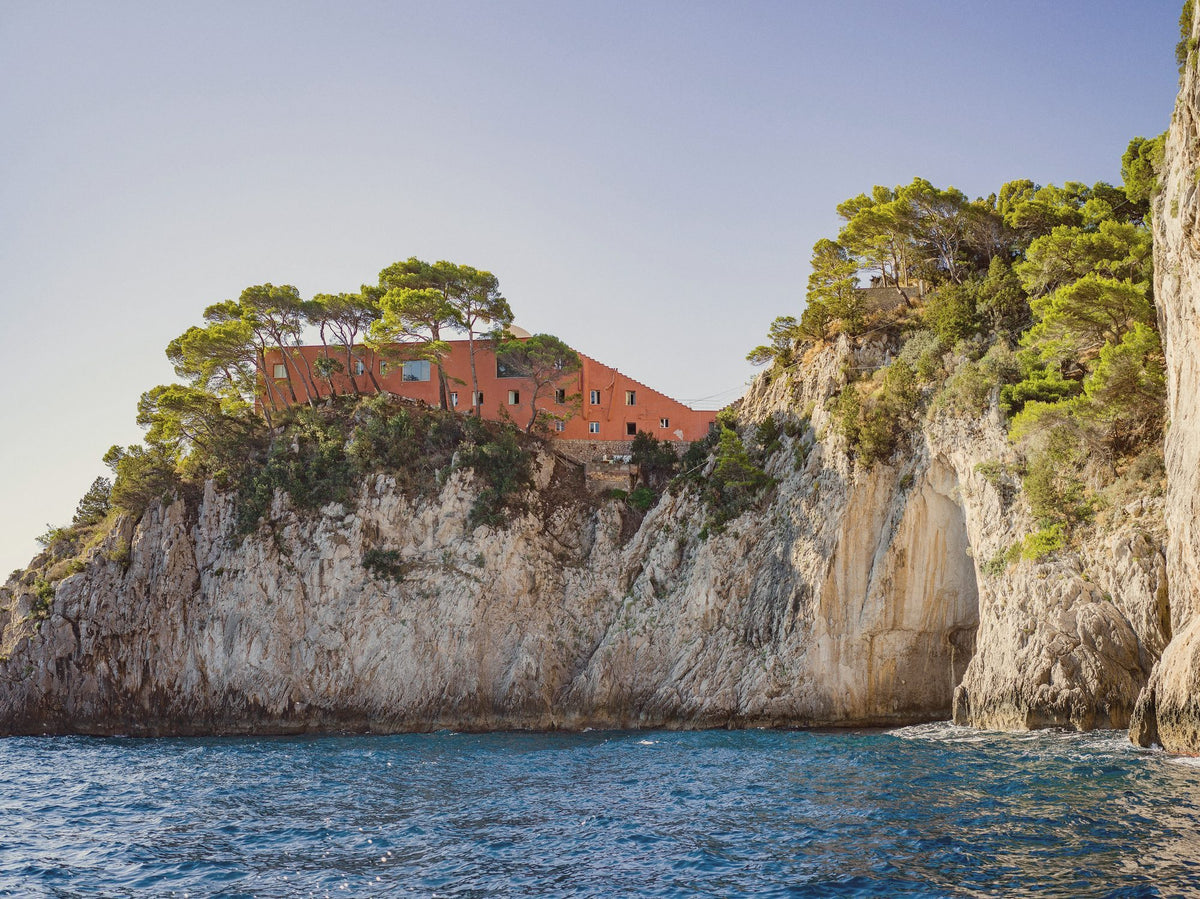
On the east coast of Capri, at Punta Massullo, a house seems to have grown straight out of the rock. Its walls are brick red, its roof is a vast terrace without a railing, and it is reached by a staircase shaped like an inverted pyramid climbing towards the sky. This is the Villa Malaparte, and it owes much of its fame to a film: Jean-Luc Godard’s Contempt (Le Mépris).
A writer’s house
It was built in the late 1930s and early 1940s for the Italian writer and journalist Curzio Malaparte, author of Kaputt and The Skin. The original design is attributed to the architect Adalberto Libera, but Malaparte, a man of strong character, is said to have substantially altered the plans and directed the works himself with local masons. The house’s exact authorship is still debated among architectural historians.
Malaparte called it “a house like me”. Austere, proud, solitary, turned towards the sea: the description suited him rather well.
The film
In 1963, Jean-Luc Godard adapted Alberto Moravia’s novel Il disprezzo. A screenwriter, played by Michel Piccoli, is hired by an American producer to rewrite an adaptation of The Odyssey being shot by the great director Fritz Lang, who plays himself. Meanwhile his wife, Camille, played by Brigitte Bardot, falls out of love with him, without his understanding why.
The whole last part of the film takes place on Capri, at the Villa Malaparte. Bardot reads, stretched out on the roof terrace. Piccoli climbs up and down the great staircase. The sea, an almost unreal blue, surrounds everything. These scenes have become some of the most famous of the New Wave.
The score for Contempt, composed by Georges Delerue, is one of the most recognisable in film history. Its “Camille’s Theme”, a few bars of strings repeated like a lament, has since been reused in many other films, including Martin Scorsese’s Casino.
A film about cinema
Contempt is also a film about filmmaking. It shows a shoot, rushes projected in a screening room, a producer who despises art, an old master who defends it, and a camera that, from the very first scene, turns towards the audience. Godard settles his scores with the industry while signing what is, on the surface, his most classical film, in colour and CinemaScope.
Visiting the villa?
The Villa Malaparte is not open to the public. It belongs to a foundation and is reserved for cultural events or invited visitors. You can, however, glimpse it from the coastal path starting at the Tragara belvedere, or from the sea, by boat, on a tour of the island. That is perhaps the best way to see it: as in the film, alone, facing the Mediterranean.
Some houses are sets. This one is a character.


